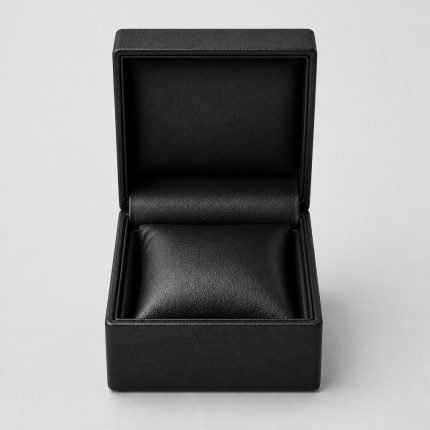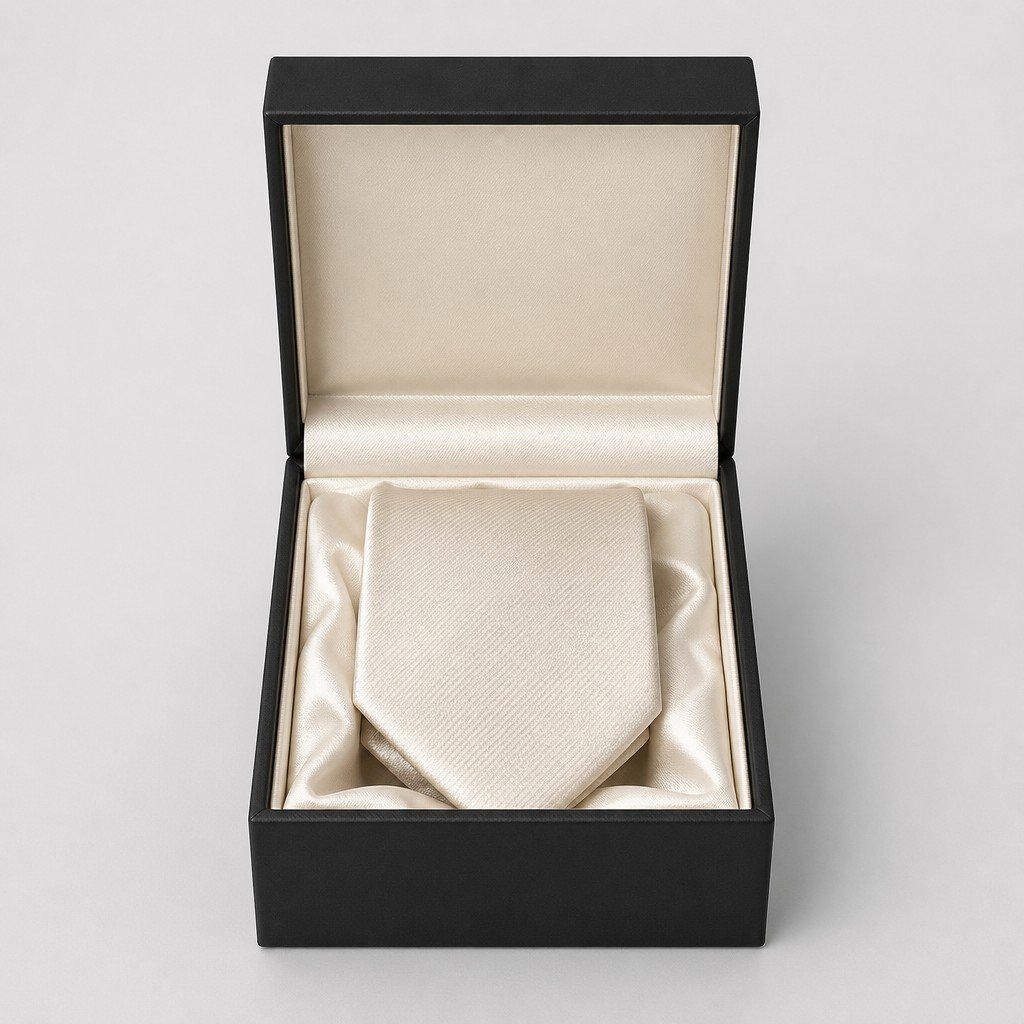


A tie is a soft product, which is exactly why the box matters. Nothing holds its shape, so the box and the insert do all the work of making it look like something worth giving.
Structure
Rigid grey board forms the base and lid, wrapped in art paper or fabric. The lid is a separate telescoping piece; where the box is meant to be opened in front of a customer, the lid can be hinged so it stays attached and does not need a surface to be set down on.
The insert is the whole problem
A folded tie has a rounded fold on one side and two flat tails on the other. If the insert presses the fold, the silk takes a crease that does not come out. The usual solution is a shaped recess under the fold — a soft channel that the fold sits in without contact pressure — combined with a flat platform under the tails. Where the tie is presented rolled rather than folded, the insert becomes a ring and the box becomes deeper and narrower.
Send the tie’s folded length, its width at the widest point, and whether it will be folded or rolled. Those three answers decide the interior; the box follows.
Wrap and finish
Art paper with matte lamination is the workhorse: it takes print accurately, keeps a flat colour even, and does not show fingerprints the way a gloss wrap does. A fabric or textured wrap raises the perceived price point and is usually reserved for the gift channel rather than bulk retail. Foil stamping, embossing and spot UV all apply, and the wrap is where a brand gets the most perceived value per unit of cost.
Presentation details
A ribbon pull, a magnetic closure or a sleeve change how the box opens, and opening is most of the experience. A magnetic lid that closes on its own is the cheapest way to make a rigid box feel expensive; a ribbon is the cheapest way to make it feel traditional. Either is specified at quotation stage, because both change the structure.
Ordering
Standard MOQ is 3,000 pcs per design, with smaller or larger quantities produced to order. Sampling takes 3–15 days depending on whether the insert needs new tooling; mass production 7–20 days after sample and artwork approval. Send the tie dimensions, the presentation style, and the wrap direction.