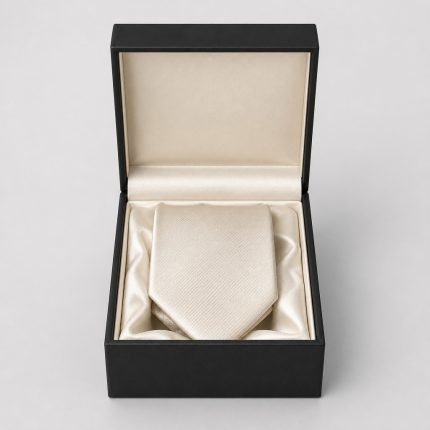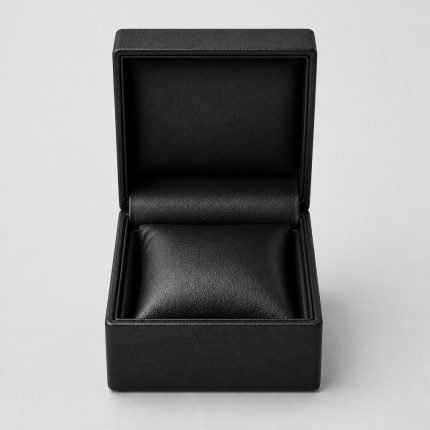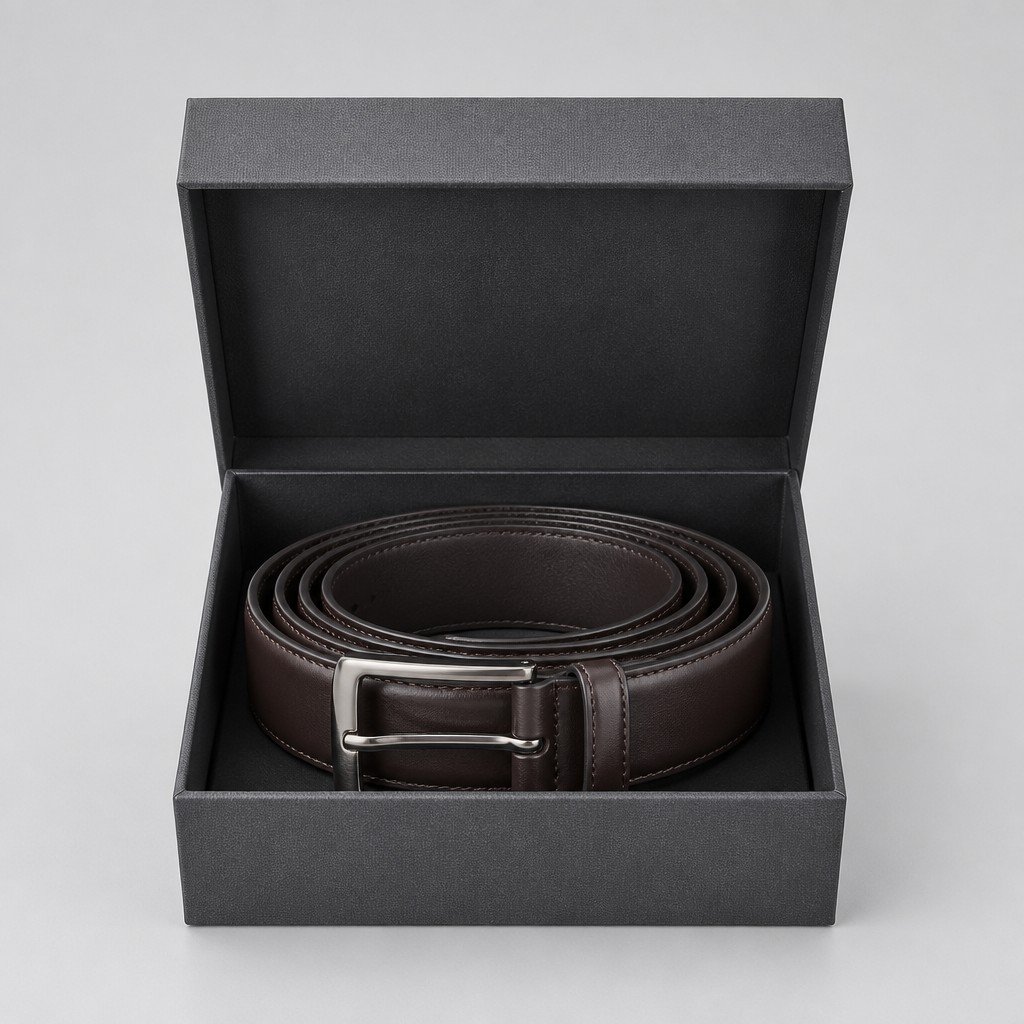


A rigid belt gift box is the point where a leather belt stops being an accessory and starts being a gift. This box is built around your belt’s actual coiled diameter and height, with a lid that closes on concealed magnets so the pack opens with a deliberate, quiet snap rather than a fold-over tuck. Retailers use it for belt-only presentation; brands use it as the outer layer of a belt-and-buckle set.
Structure
Grey board forms the walls and lid, wrapped in art paper or fabric so the board never shows at the edges. The lid is a separate telescoping piece with two embedded magnets aligned to steel plates in the base — no visible hardware, no ribbon required to keep it shut. The base interior is cut to hold the belt in a single coil, which prevents the leather from taking a permanent crease during transit. For belts presented with a buckle facing the lid, the insert can be recessed on one side so the buckle sits proud without pressing the lid.
Material and finish
The wrap is where most of the perceived value sits. Standard options are 128–157 gsm art paper in matte or gloss lamination, or a soft-touch film that photographs badly and feels expensive in the hand. Textured and fabric wraps are available for higher price points. If the box needs to show the belt itself, a PET or PVC window can be cut into the lid at 0.35–1.15 mm film thickness — PET as standard, PVC where a softer fold is needed.
Printing is offset CMYK with Pantone matching, and the wrap can carry foil stamping, embossing, debossing or spot UV. Because the wrap is applied over a flat board before assembly, registration on a two-piece box is tighter than on a folding carton — worth knowing if your artwork has a pattern that must run continuously across lid and base.
Insert
Three insert routes cover most belt programmes: a die-cut EVA foam ring that grips the coil, a moulded pulp tray for a more sustainable story, or a paperboard platform with a satin or elastic band. Foam holds the belt most securely and is the usual choice when the box ships direct to consumer; paperboard is lighter and cheaper per unit at volume.
Load and transit
Because the box is rigid and the lid is magnetic, it survives parcel handling far better than a folding carton. The limit is not the box but the belt: a heavy buckle concentrates load on one point of the insert, so tell us the buckle weight at inquiry stage and the foam density or board platform is specified accordingly. Boxes are shipped assembled, nested in export cartons with dividers.
Compliance
Paper and board grades can be quoted to FSC-certified stock on request. Where the box touches the product directly, we confirm the wrap and adhesive specification against the market you are selling into — EU and US requirements differ on recycled content claims and on ink migration for food-adjacent packs. Tell us the destination market at inquiry stage and the correct grade is quoted rather than assumed.
Why rigid rather than a folding carton
A folding carton is cheaper per unit and ships flat, which matters at high volume and low price points. A rigid box costs more and ships assembled, but it does two things a folding carton cannot: it holds its shape when a customer lifts the lid, and it makes the magnet close on its own. For a belt sold at retail above roughly 40 dollars, that difference tends to pay for itself. Where the budget does not stretch, a folding carton with a magnetic-look tuck flap is the usual compromise — we quote both so you can compare on landed cost rather than unit cost.
Ordering
Standard MOQ is 3,000 pcs per design. Smaller or larger quantities can be produced to order — send the quantity and we quote it. Sampling takes 3–15 days depending on whether a new die and wrap template are needed; mass production runs 7–20 days after you approve the sample and artwork. Send belt dimensions, coil diameter, buckle weight, wrap preference and artwork status, and the quotation covers tooling, unit cost and delivery schedule in one pass.