

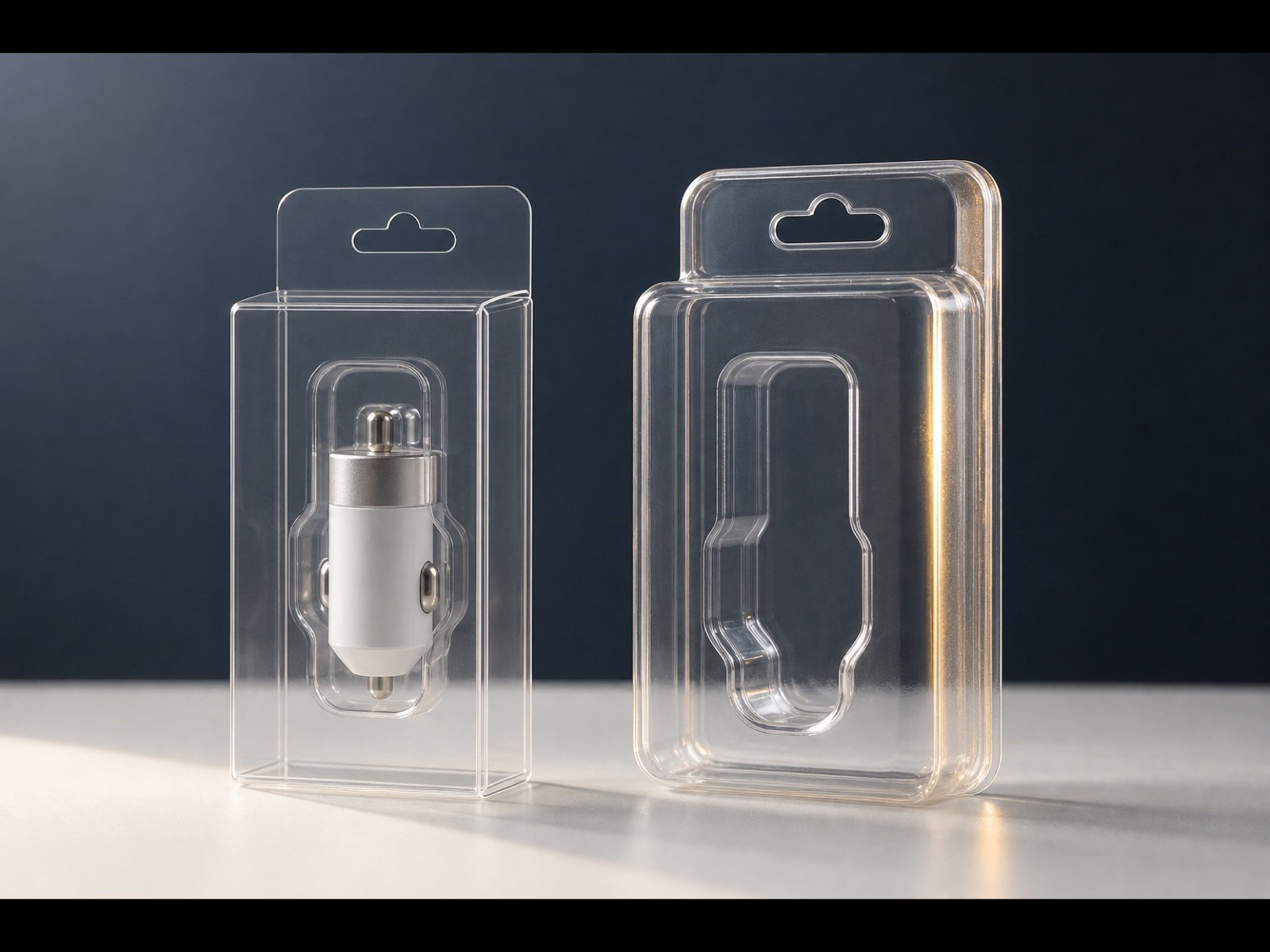
Almost every custom plastic packaging enquiry arrives with the same question attached: PET or PVC? The answer is usually PET, and the reason is not that it is cheaper or clearer. It is that one of the two materials gets collected and reprocessed in most of the markets our customers sell into, and the other largely does not.
What actually differs between them
Both are thermoplastics, both can be thermoformed, printed and die-cut, and both come in sheet from roughly 0.35 mm upward. On a specification sheet they look almost interchangeable. The differences that matter sit elsewhere.
| PET | PVC | |
|---|---|---|
| Recycling stream | Widely collected — the bottle stream, with established rPET supply | Rarely collected in municipal systems; effectively single-use in most markets |
| Clarity | High; the standard choice where the product must be seen | Also high, and slightly more forgiving on a deep draw |
| Formability | Good, but deep undercuts and tight radii need care | Better — this is where PVC genuinely wins |
| Scratch resistance | Moderate; scuffs show on a clear pack | Higher; a practical reason it survives retail handling |
| Printing | Requires surface treatment for reliable ink adhesion | Prints readily |
| Cost | Generally comparable | Comparable, often similar on a like-for-like gauge |
Why PET is the default
Not because the material performs better on every measure — it does not. Because the pack’s end of life is decided by the market it is sold into, not by the factory that made it. In Germany, France or the Netherlands, a PET box has a realistic chance of entering a recycling stream. A PVC box in the same bin is a contaminant.
There is a second reason: recycled PET exists as an established, certifiable material with chain of custody. If a customer needs to state a recycled content figure, that route is available in PET and largely is not in PVC. Choosing PVC removes an option that cannot be added back later without retooling.
When PVC is the right answer
There are real cases. A deep cavity with an undercut that PET cannot form without thinning at the corner. A pack that will be handled repeatedly in a retail environment and must not show scratches. A product where the box is genuinely reused — a tool case, a storage box — so the pack is not entering the waste stream in the short term at all.
In each of those, the honest position is that PVC is being chosen for a physical property, and the end-of-life consequence is a trade-off being made deliberately. That is a legitimate decision. What is not legitimate is specifying PVC by default because it forms more easily, and then writing “eco-friendly” on the box.
What to send us
- The product. Dimensions and weight, and whether it is fragile.
- The market. Recyclability is a market property, not a material one.
- Whether the pack is kept. A presentation box that lives on a shelf has a different calculus from a blister torn open at the till.
- Any recycled content requirement, and whether it is a claim or a procurement rule.
With those, the recommendation is usually one line long. Without them, any answer is a guess dressed up as advice.